One AI Teammate, Five Workflows: How Mega Teams Are Replacing Fragmented Automation With Agentic Operations
July 31, 2026 written by Fello


TL;DR
- Stacking point tools creates noise; agentic workflows collapse dialers, drips, and ISA software into one coordinated system that reasons and executes.
- McKinsey research shows agentic organizations report meaningful reductions in cycle times and fewer handoffs — the gap between early adopters and everyone else is already widening.
- An agentic AI teammate qualifies, follows up, routes, and logs without waiting for a human to trigger the next step.
- One large team generated approximately 188 listing appointments from their existing 200,000-contact database without buying a single new lead.
- Predictable, profitable growth doesn't come from adding more seats — it comes from building systems that never let a good opportunity go cold.
Your Stack Is the Problem
You've probably invested in a dialer. You've got drip campaigns running. Maybe you have an ISA platform, a retargeting tool, and a CRM with a dozen custom tags. On paper, it looks like a system. In practice, it behaves like a pile.
Each tool has its own login, its own logic, and its own failure mode. The dialer doesn't know what the drip sent. The drip doesn't know what the CRM logged. Your ISA doesn't know what fired overnight. And somewhere in those gaps, a contact who was quietly signaling readiness slipped through without anyone noticing.
McKinsey's research on agentic organizations found that teams running true agentic operations report meaningful reductions in cycle times and fewer handoffs between disconnected systems. That's not a marginal efficiency gain. That's a structural advantage that compounds every quarter. Mega teams that understand this are collapsing their fragmented stacks into something fundamentally different: a single agentic AI teammate that reasons, qualifies, follows up, routes, and logs across the entire database without requiring a human to orchestrate every step.
What "Agentic" Actually Means in Practice
Most teams have heard the word agentic by now. Fewer understand what separates it from the automation they're already running.
MIT Sloan defines agentic AI as systems that execute multi-step plans, use external tools, and integrate with existing software to complete work autonomously. That's not a drip campaign. A drip campaign sends pre-written messages on a fixed schedule. It doesn't read context, it doesn't qualify intent, and it doesn't decide what to do next based on what the contact actually did.
The distinction matters enormously in real estate operations. As covered in the Fello series, the difference between a drip campaign and an agentic AI teammate is not cosmetic. One executes a schedule. The other reasons about a contact's equity position, engagement history, and property data, then decides what outreach to initiate, how to respond to a reply, and when to route a warm conversation to a human agent.
Insight Partners frames this transition as the replacement of brittle, fragmented systems with agents that own end-to-end processes. In real estate terms: your database already contains the next 50 deals. The question is whether your follow-up infrastructure can find them before the contacts call someone else.
Five Workflows Mega Teams Are Running Right Now
Workflow 1: Database Re-engagement and Sphere Warming
The fragmented version of this workflow looks like a manually curated call blitz list that goes stale between weekly reviews, a drip sequence running on outdated email addresses, and a team hoping someone remembers to circle back on contacts flagged six months ago.
The agentic version starts with a living database. Fello's data enrichment layer updates equity positions, home values, ownership changes, and intent signals continuously. When a contact's equity crosses a threshold, or MLS activity picks up in their neighborhood, or they engage with a market report at midnight, an agentic AI teammate doesn't wait for someone to notice. He reasons about that signal, decides whether it warrants outreach, and initiates the right conversation at the right time.
This is why fragmented follow-up is the actual problem in most large databases, not the quality of the contacts inside them. The sphere is warm. The follow-up is cold.
Workflow 2: Inbound Lead Response
Speed-to-lead failure is expensive and well-documented. Many teams find that inbound inquiries go cold simply because no one responded within the first few minutes. ISA coverage windows have gaps. After-hours leads wait until morning. By then, the contact has moved on.
An agentic AI teammate running 24/7 inbound handling changes the math on this entirely. Felix, Fello's AI teammate, handles inbound calls, texts, and follow-up emails from one coordinated system. When a contact reaches out, he's already grounded in their property data and engagement history before the conversation begins.
The critical detail here is what happens at the moment of readiness. Felix doesn't just flag a contact as "interested" and send a notification. He qualifies to a commercial standard — understanding whether the contact will sell if the number is right — and then bridges the call live to an available agent so that agent picks up mid-conversation with full context. If timing isn't right, Felix schedules a callback instead. In both cases, call notes are automatically saved in the CRM. That's a warm handoff, not a cold transfer.
The concern some operators raise about always-on AI is real: does this feel impersonal? The answer is in the handoff design. An agentic system that's always on but routes intelligently to humans at the right moment is superior to a system that's only on during business hours. Felix is always on and always working toward a human close.
Workflow 3: Outbound Prospecting and Long-Term Nurture
Most large teams have a version of this problem: a dialer for outbound calls, a separate platform for email drips, maybe a texting tool on top of that. Three logins. Three sets of data that don't talk to each other. And a contact who got a call, two automated emails, and a text — all saying different things, none of them aware of the others.
Felix runs calls, texts, and follow-up emails from one coordinated system. He builds a personalized strategy for every contact using past conversations, changing property data, and real-time engagement signals, then decides what to do next on his own. He doesn't follow a static sequence that treats a contact the same in month one and month fourteen.
The scale implication is significant. Felix can run 1,000 simultaneous conversations — a volume no ISA team can match without adding headcount, management overhead, and training cycles that eat into the margin those conversations are supposed to generate.
One large team generated approximately 188 listing appointments from their existing 200,000-contact database using this approach, without buying a single new lead. The ROI was measurable within 60 days.
Workflow 4: Seller Identification and Listing Pipeline
The manually curated "hot list" is one of the most expensive workflows in real estate operations. A director of operations or lead ISA spends hours each week pulling contacts by hand, sorting by last activity, guessing at who might be ready. By the time the list gets to the agents, half the signals it was built on have already changed.
An agentic approach replaces that manually curated list with a living database that surfaces who has high equity, who is approaching a move trigger, and who has been engaging with market content, before the contact ever raises their hand. Fello's Living Database component continuously updates contact and property data, enriching every contact across equity, home value, ownership changes, interest rate sensitivity, and intent signals.
The agentic AI teammate then activates those contacts proactively. This is the "Fello finds it, Felix works it, your team closes it" model operating at scale: the platform identifies the opportunity, the AI teammate runs the qualification, and the human agent steps in only when the conversation is ready to become a listing appointment.
This also matters for agent continuity. When a team member leaves, the revenue leak isn't just the relationships they take with them — it's the follow-up that was running through their personal memory and their cell phone. An agentic system decouples follow-up from any individual agent's behavior. If the follow-up runs through the platform rather than the agent, the relationship survives the departure.
Workflow 5: Warm Handoff to Close and Agent Routing
This is the moment the entire agentic loop is built toward. Every qualified conversation Felix runs, every signal the living database surfaces, every piece of engagement data that builds a contact's profile — all of it is designed to produce one outcome: a warm handoff to a human agent who steps in with full context and closes.
When Felix qualifies a contact to the point of readiness, he bridges the call live. The agent picks up mid-conversation. Call notes are already in the CRM. The agent knows the contact's equity position, the conversation history, and what it would take to move forward. There is no "let me pull you up in the system" moment. The context is already there.
Andrew Undem of Sure Group, a Fello beta participant, activated Felix on an initial wave of 5,000 contacts with another 5,000 planned within three weeks. His concern wasn't whether Felix could handle the volume. It was whether his team could keep up with the handoffs Felix generates. He called it a good problem. That framing matters: the output of a well-configured agentic system isn't a manageable trickle of warm leads. It's a volume that challenges the team to staff the close.
Collapsing the Stack: Why Consolidation Beats Optimization
Teams that try to fix the fragmentation problem by optimizing each tool separately are solving the wrong problem. Insight Partners' analysis of enterprise agentic workflows is direct on this point: brittle, disconnected systems create noise even when each individual tool is performing. The problem isn't the tools. It's the gaps between them.
Fello Workflows connect the living database, Felix's outreach, and CRM handoffs into a single operational chain using if-then logic. Every handoff Felix creates generates an event and a tag pushed directly into the CRM — into Follow Up Boss natively, and into other CRMs via Zapier. The integration with Follow Up Boss takes about five minutes to configure, and onboarding is complete in a matter of hours. No new silo. No duplicate data entry. No manual orchestration between systems.
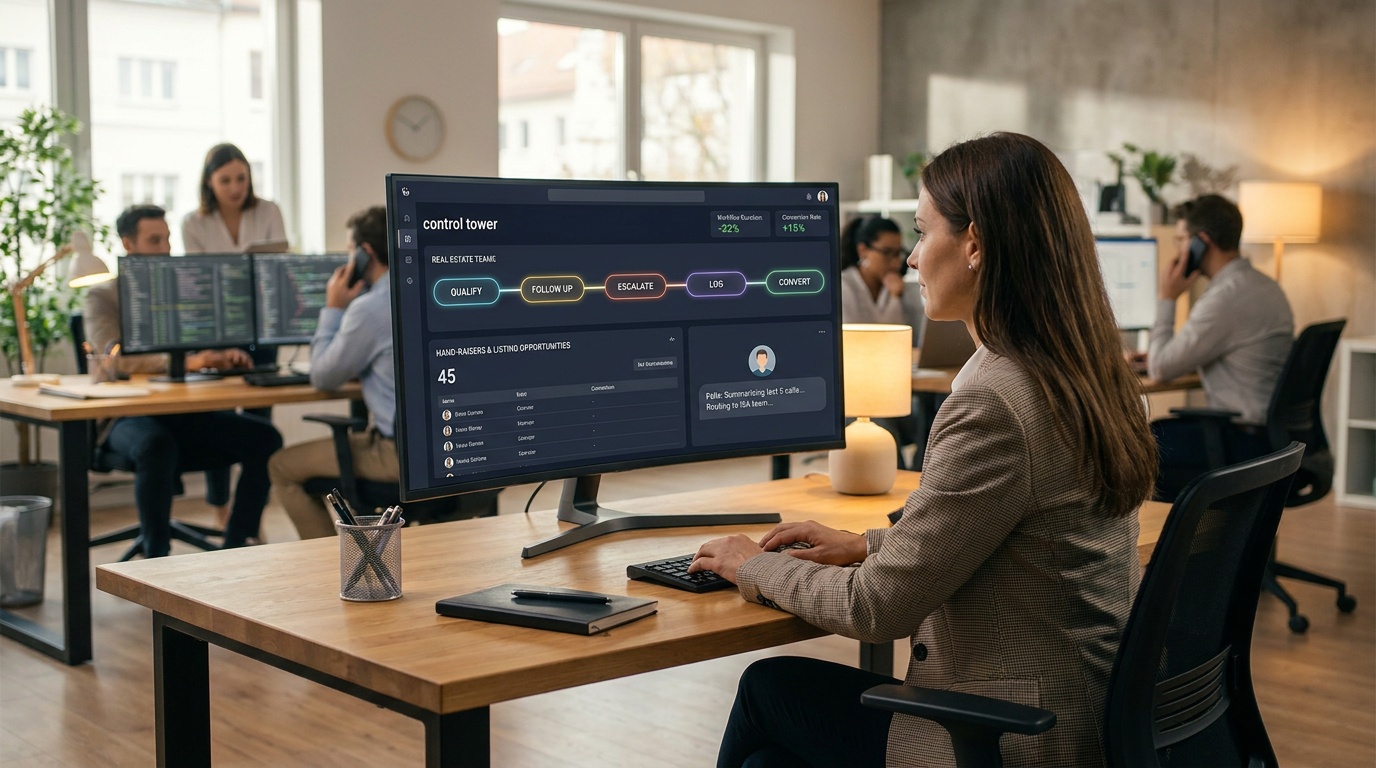
Ask AI in Fello 3.0 extends this further: operators can query the living database in plain English — "which contacts in ZIP code 78701 have over 40% equity and haven't been contacted in 90 days?" — and get actionable insights instantly rather than running a custom report through a separate tool. That's the control tower view most directors of operations are missing, and it's what agentic workflows are built to provide.
Getting the Governance Right
TechNode's analysis of the shift from AI copilots to AI teammates identifies three principles that make agentic operations sustainable: bound the job clearly, assign a human owner per workflow, and keep humans in the loop for high-stakes decisions.
That framework maps directly to how responsible teams are deploying agentic operations. Felix is configured with explicit exclusions: personal sphere, past clients, contacts in active sales stages. Teams control which lead sources he works and when he backs off once an agent takes over. Felix identifies himself as a digital assistant for compliance and transparency. Compliance responsibility — including DNC scrubbing, consent, state-specific calling laws, and 10DLC approval for SMS — rests with the team. A true agentic operations setup requires those configurations to be in place before activation.
The BakedWith pilot-first adoption framework offers a practical entry point for teams not yet ready for full database deployment: establish openness to the model, identify the highest-friction workflow in your current stack, start with a bounded pilot (one lead source, one contact group, one workflow), evaluate the handoff quality, then roll out with monitoring in place. One Fello account was onboarded in under four minutes and received its first handoff within the hour. The barrier to starting is genuinely low.
Frequently Asked Questions
What makes an agentic AI teammate different from the ISA software we're already running?
ISA software is a workflow tool that helps a human ISA manage their tasks. An agentic AI teammate reasons about each contact independently, decides what outreach to initiate, qualifies intent across a multi-step conversation, and routes the warm handoff to a human agent, without a human ISA triggering each step. The ISA function is still essential for high-stakes conversations. The agentic teammate handles the volume and consistency that make those conversations possible.
How does Felix know when to hand off to a human versus keep working a contact?
Felix qualifies to a commercial standard: not just "expressed interest" but "ready to move if the number is right." When that threshold is met and an agent is available, Felix bridges the call live so the agent steps in mid-conversation. If timing isn't right, he schedules a callback. In both cases, full call notes and context are automatically saved in the CRM. The human agent never steps into a cold conversation.
What happens to contacts we've already uploaded to a dialer or drip tool?
Those contacts belong in the living database first. Fello's data enrichment layer updates their property data, equity position, ownership status, and engagement signals before any outreach begins. Running outreach on stale data produces the noise problem the article describes. The practical recommendation is to get data enrichment running now, so when an agentic AI teammate activates on your database, every conversation starts from accurate context.
Can we control which contacts Felix works?
Yes. Teams configure which lead sources Felix works, which groups he leaves alone (personal sphere, active pipeline, past clients), and when to disengage once an agent takes over. That configuration is part of what makes the system governable rather than uncontrolled. The governance framework is built in, not bolted on.
Is our team going to lose accountability over follow-up if an AI is running it?
The opposite is true for well-configured teams. When follow-up runs through the platform rather than through individual agents' memories and personal devices, accountability becomes measurable and auditable. Every conversation Felix runs is logged. Every handoff generates a CRM event. A director of operations can see exactly what happened with every contact, rather than relying on an agent's self-reported activity.
What's the right first workflow to pilot for a mega team?
Start with the highest-friction, lowest-risk workflow in your current stack. For most mega teams, that's long-term database re-engagement: contacts who haven't been touched in 90-plus days, no active agent relationship, and property data that's almost certainly stale. This group has the most upside and the least risk of disrupting active agent relationships. Measure handoff quality over 30 days, then expand from there.
Buying Tip
Before an agentic AI teammate can work your database, the database has to be worth working. The single most valuable thing a mega team can do right now is run data enrichment on their full contact list: clean the property data, update equity positions, identify ownership changes, and surface intent signals. Teams that arrive with enriched data get their first handoffs faster — in some cases, within the hour. Start with enrichment now so you're on appointments the moment he activates.
The New Scoreboard
Mega teams replacing fragmented automation aren't just cutting software costs. They're switching scoreboards.
The old scoreboard measured activity: most leads purchased, most calls dialed, most drips sent. The new scoreboard measures outcomes: profitable growth from the database the team already owns, month after month, without the overhead of a tool stack that requires constant human orchestration to function.
Your database is already full of the next deal. Agentic operations are how you build a system reliable enough to find it — every time, not just when someone remembers to look.