Felix vs. Hiring an ISA: The Real Math for a Team with 10+ Agents
August 20, 2026 written by Fello


TL;DR
- A fully loaded in-house ISA costs approximately $4,583–$7,083 per month in 2026, and most teams are hiring again within a year.
- ISAs can only meaningfully manage around 500–1,000 contacts at a time, which means a growing database will always outgrow your headcount.
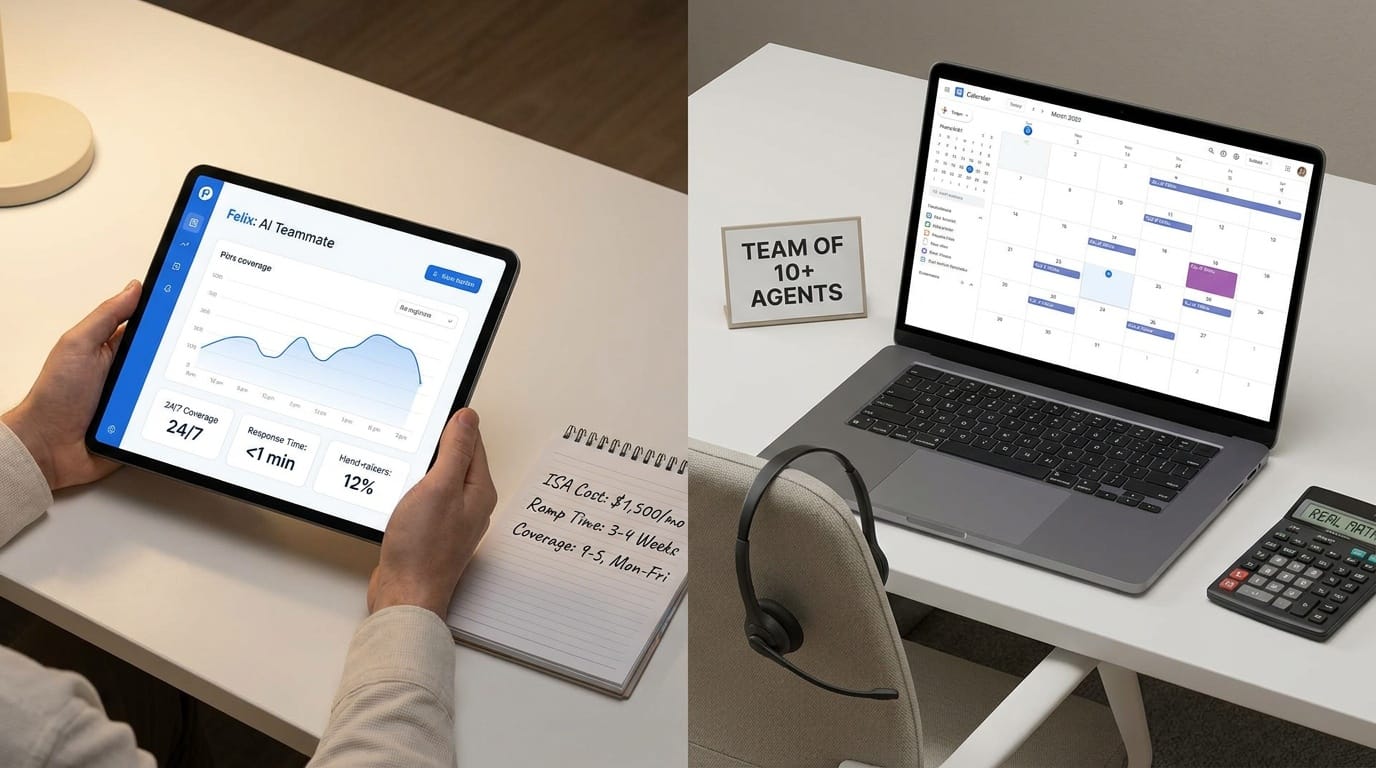
- Felix runs follow-up 24/7 across calls, texts, and emails at a fraction of ISA cost, with no ramp time, no turnover, and no coverage gaps.
- One additional listing from your existing database covers Felix's annual cost.
- The question for a 10+ agent team isn't whether you need follow-up coverage. It's whether hiring is the right way to get it.
Introduction
If your team has 10 or more agents, you already know the follow-up math doesn't work. You've got a database full of past clients, sphere contacts, and previous leads. You've got agents who are too busy closing to prospect. And you've got ISAs who cover business hours, call a slice of the database, and then leave, burn out, or get poached before they've paid for their own ramp time.
The answer most team leaders reach for is another hire. Another ISA, another coordinator, another layer of management to hold it all together. But the problem isn't headcount. The problem is that follow-up at scale is fundamentally a systems problem, not a staffing problem.
That's what this article is about: the real cost comparison between building out your ISA bench and adding Felix, Fello's AI teammate, to your existing operation. Not the theoretical math. The operational reality that team leaders with 10-plus agents are doing the math on right now.
(If you're earlier in your growth curve and working with one or two ISAs, we broke down that scenario in Felix vs. Hiring Another ISA: The Real Math for Growing Teams. This article steps up in scope to the 10-plus agent team where the coverage problem compounds fast.)
What an ISA Actually Costs in 2026
Before you can do the comparison, you need an honest number. Most teams undercount the real cost of an ISA because they're looking at salary alone.
According to current ISA cost benchmarks, a fully loaded in-house ISA runs approximately $4,583–$7,083 per month in 2026 when you factor in salary, benefits, taxes, management overhead, and tools. Virtual ISA services cost less, ranging from approximately $720–$1,988 per month, but come with trade-offs in control, training, and consistency.
Offshore and outsourced ISA teams run approximately $800–$1,800 per month per seat, with all-inclusive in-house packages reaching $4,000–$6,500 per month. For a 10-agent team that wants real ISA coverage, that math escalates quickly. If you're running three ISA seats at $1,500 per month each, you're at $4,500 per month before you've accounted for the hidden costs: ramp time, turnover, and the weeks of follow-up that go dark every time someone leaves.
And turnover is not a small problem. Many teams find that ISA turnover costs tens of thousands of dollars per transition event in lost follow-up and missed opportunities. A new ISA typically operates well below full quota capacity during their ramp period, which means for the first 60–90 days, your database isn't being worked at full intensity. Hand-raisers who surface during that window don't get contacted at their peak intent moment. That's not just an operational inconvenience. That's revenue walking out the door.
The Coverage Ceiling Nobody Talks About
Here's the operational reality that doesn't show up in the job description: a single ISA can meaningfully manage around 500–1,000 contacts at a time. Part-time virtual ISAs cost approximately $800–$1,200 per month and cover even less. Full-time virtual ISAs run approximately $1,500–$3,000 per month, and they still work on a schedule.
For a team with 10 agents, your database is almost certainly larger than 1,000 contacts. If you've been in business for more than a few years, you likely have 5,000, 10,000, or more contacts across past clients, sphere, purchased leads, and orphaned agent databases. An ISA working through a prioritized call list is covering the top of that pile. Everyone below the fold isn't getting touched.
This is where The Lead Trap takes hold. Teams assume the answer is buying more portal leads to fill the pipeline, when the real problem is that they're not working the database they already have. The contacts are there. The opportunity is there. The follow-up system isn't.
A team that generated 188 listing appointments from an existing 200,000-contact database using Fello's predictive scoring and follow-up system is the proof point that reframes this problem entirely. The question was never "where do we find more leads?" It was "are we working what we already have?"
What Felix Does Instead
Felix is Fello's AI teammate. He runs follow-up across calls, texts, and emails, 24 hours a day, seven days a week, without a schedule, without a bad quarter, and without a two-week notice.
The coverage difference is not incremental. Felix can run 1,000 conversations simultaneously. He reads live property data before every outreach, including equity position, time in home, interest rate, and engagement history, and he adapts based on signals rather than a static script. When a homeowner opens their home value report at 11 p.m. on a Sunday, Felix sees that signal and responds. A human ISA on a Monday-through-Friday schedule misses it entirely.
Research consistently shows that responding within 5 minutes makes a contact significantly more likely to convert, and many teams find that prioritizing fast response leads to meaningfully higher appointment-setting rates. Felix's 24/7 availability isn't a nice feature. It's a structural advantage that protects more appointments from the same database without adding headcount.
He runs on Fello's Living Database, which means he's always working from current data, not a stale export. Every contact gets enriched continuously. Equity changes, engagement signals, lifecycle transitions, and MLS data feed into every conversation Felix initiates. He doesn't call someone with generic small talk. He calls with context.
When a contact is ready to move forward, Felix delivers a warm handoff. The agent receives the full conversation history, property context, and recommended next action. Call notes are saved automatically in the CRM. If the contact is available live, Felix bridges the call so the agent steps into a conversation already in progress. The agent doesn't have to start from scratch. They step into momentum.
Felix integrates natively with Follow Up Boss. For other CRMs, Zapier handles the connection.
The Real Math for a 10-Plus Agent Team
Let's put numbers on it.
A three-ISA operation at the conservative $1,500 per month offshore rate runs $4,500 per month, or $54,000 per year. At the all-inclusive in-house rate, that same coverage costs approximately $12,000–$19,500 per month, or $144,000–$234,000 per year. Neither figure includes turnover costs, which can be substantial and happen regularly in this role.
AI-driven follow-up has already demonstrated market traction at well under 10% of ISA cost, with examples in market showing 500 leads nurtured for approximately $520 per month. That positions Felix's economic model not as a theoretical alternative but as a proven category with real operator adoption.
Specific Felix pricing requires a conversation with the Fello team, because the right configuration depends on database size, team structure, and current coverage. What the Fello context makes clear is that one additional listing from the database covers Felix's annual cost. For a team producing at the 10-plus agent scale, that's a low bar. The question isn't whether Felix pays for itself. It's how many times over.
The Lance Loken Group put it plainly: Fello is 14% of their business, and they're getting 4–6 extra listing conversations per month from their existing database that they weren't having before. For a team that size, four to six additional conversations per month compounds quickly.
Where a Human ISA Still Belongs
This comparison isn't an argument that human ISAs are obsolete. The right framing is that Felix elevates great ISAs by handling volume, coverage, and off-hours outreach so the human team can focus on the conversations that actually need them.
There are moments in the sales process where a human is irreplaceable. Emotional conversations around divorce, death, or financial stress. Listing presentations where relationship and trust are doing the work. Final scheduling and booking where the context of the conversation needs to be held carefully.
Felix handles the volume work: the fifth follow-up text at 9 p.m., the inbound call at midnight, the 50,000-contact database that no ISA team could ever fully cover. He qualifies contacts and passes warm handoffs to the ISA or directly to the agent, depending on the team's workflow configuration.
For a 10-plus agent team, the question isn't whether to replace your ISA. It's whether you need to keep hiring more ISAs as you scale. Felix absorbs the volume that would otherwise require additional headcount, which means the human ISA can stay focused on the most meaningful conversations rather than cycling through the bottom of a cold list.
The Operational Advantages That Don't Show Up in the Budget
Beyond the monthly cost comparison, Felix solves several problems that ISA headcount never fully addresses.
No ramp time. Felix is ready in four minutes. Early accounts have received their first handoffs within the hour of turning him on. There is no 60-day ramp, no scripts to write, no training plan to build.
No coverage gaps. Holidays, weekends, sick days, and turnover events don't create dead zones in follow-up. Felix runs whether the team does or not.
No embarrassing AI moments. Felix reads live Fello data before every conversation. He's not using a generic script. Live recordings of Felix played to rooms full of agents produced zero identification. Nobody could tell the caller wasn't human.
No management overhead. Felix determines his next outreach based on signals, not a configurable cadence someone has to maintain. The team doesn't build sequences, manage a dialer, or babysit a follow-up system. Felix makes the decisions and executes them.
These are the operational advantages that disappear in the line item comparison but show up every week in the team leader's calendar, or notably, don't show up because they no longer need managing.
Frequently Asked Questions
Does Felix actually sound like a human caller?
Yes. Live recordings of Felix have been played in rooms full of real estate agents, and most listeners don't identify him as an AI caller. Felix identifies himself as a digital assistant during conversations, but his voice quality, conversational responsiveness, and contextual awareness are consistently indistinguishable from a human. Fello describes today's voice and conversation quality as the floor, not the ceiling.
Can I control which contacts Felix reaches out to?
Completely. Teams control lead sources, contact exclusions, and agent takeover triggers. Felix works from your Living Database, which means you decide what's active and what's not. TCPA compliance is the team's responsibility, and Fello provides DNC scrubbing, calling hour controls, and contact exclusion tools. Fello strongly recommends consulting an attorney who knows calling and AI outreach rules in your market before going live.
How does Felix handle the handoff to a human agent or ISA?
When a contact signals real intent, Felix delivers a warm handoff with the full conversation history, property context, and a recommended next action already loaded in the CRM. If the contact is live on the call, Felix bridges the conversation directly to the agent. The contact never experiences a transfer. The agent steps into a conversation already in progress with zero drop-off.
What CRMs does Felix work with?
Felix integrates natively with Follow Up Boss. Zapier integration is available for other CRM systems.
How long does it take to get Felix running?
Onboarding takes approximately four minutes. Accounts with Felix have described the process as painless and hands-on. First handoffs have arrived within hours of activation for these accounts.
When does it make sense to keep a human ISA alongside Felix?
Felix is positioned to support the ISA, not replace them. For a 10-plus agent team, Felix handles the volume, the off-hours coverage, and the full database at scale. The human ISA handles the most meaningful conversations that require relationship, emotional intelligence, and final scheduling. The practical question for a growing team isn't whether to eliminate ISA headcount, it's whether to keep adding ISA seats as volume grows. Felix absorbs that incremental volume without the hiring cost.
Buying Tip
Before your next ISA hire, pull your database contact count and run a simple capacity check. If you have more than 2,000 contacts and your ISA team is covering fewer than half of them consistently, you don't have a headcount problem. You have a coverage architecture problem. Felix is built for exactly that gap: Felix vs. Hiring Another ISA: The Real Math for Growing Teams walks through how to evaluate the math for your specific team size. Felix launched with a first-come, first-served waitlist model and onboarding capacity limits, so teams that move now also have time to get their database into the Living Database before Felix activates, which Fello positions as a meaningful readiness advantage.
Conclusion
For a team with 10 or more agents, the follow-up problem isn't a motivation problem or a talent problem. It's a scale problem. No ISA bench you can realistically hire and manage will cover your full database, work every hour of the day, and deliver consistent handoffs without turnover creating dead zones.
Felix doesn't solve this by replacing the human ISA. He solves it by absorbing the volume that was never going to get covered anyway, so the human ISA can do what they're actually good at.
The math is straightforward. The operational case is even stronger. One additional listing from your existing database covers Felix's annual cost. The database already has the opportunity. The question is whether your follow-up system is built to find it.