AI-Powered vs. Agentic AI: What's the Real Difference for Real Estate Teams?
September 26, 2026 written by Kerry Kleckner, VP of Sales


TL;DR
- "AI-powered" is a marketing label, not a technical claim. It tells you nothing about what the software actually does.
- Agentic AI means software that runs a complete, defined workflow from trigger to outcome on its own, not a feature that assists a single step.
- New-lead response is the clearest entry point: a real agentic workflow reasons, adapts, and hands off, while a drip sequence just fires on a schedule.
- The same trigger-to-outcome logic extends to follow-up, recruiting, retention, and customer experience, though not every one of those is equally mature today.
- Felix, Fello's AI teammate, is a working example of this model today, running new-lead response and database follow-up until a real handoff is ready.
- Before you evaluate another vendor, ask what specific workflow their AI runs start to finish, without a human re-entering data at every step.
Every Vendor Says "AI-Powered." None of Them Are Telling You Anything.
Open your inbox this week and count how many tools you already pay for now claim to be AI-powered. Your CRM, your dialer, your marketing platform, your transaction software. Nearly all of them.
That phrase used to mean something was new. Now it's closer to "cloud-based" was a decade ago: a label every vendor slaps on, whether or not it changes how the software actually works. And it's costing you time, because you're the one who has to sit through the pitch, figure out what's real, and decide whether it's worth changing your stack.
The real estate industry's own data backs up what this feels like on the ground. Research from JLL on real estate's AI reality check found that companies piloting AI are largely not reaching the outcomes they set out for, meaning a lot of what's being deployed right now is closer to an experiment than a working system. That gap between what's marketed and what's actually operating is exactly where "AI-powered" hype lives, and it's exactly what this article is here to fix.
The Real Distinction: A Feature Versus a Workflow That Runs Itself
Here's the test that actually matters, and it has nothing to do with how advanced the underlying model is.
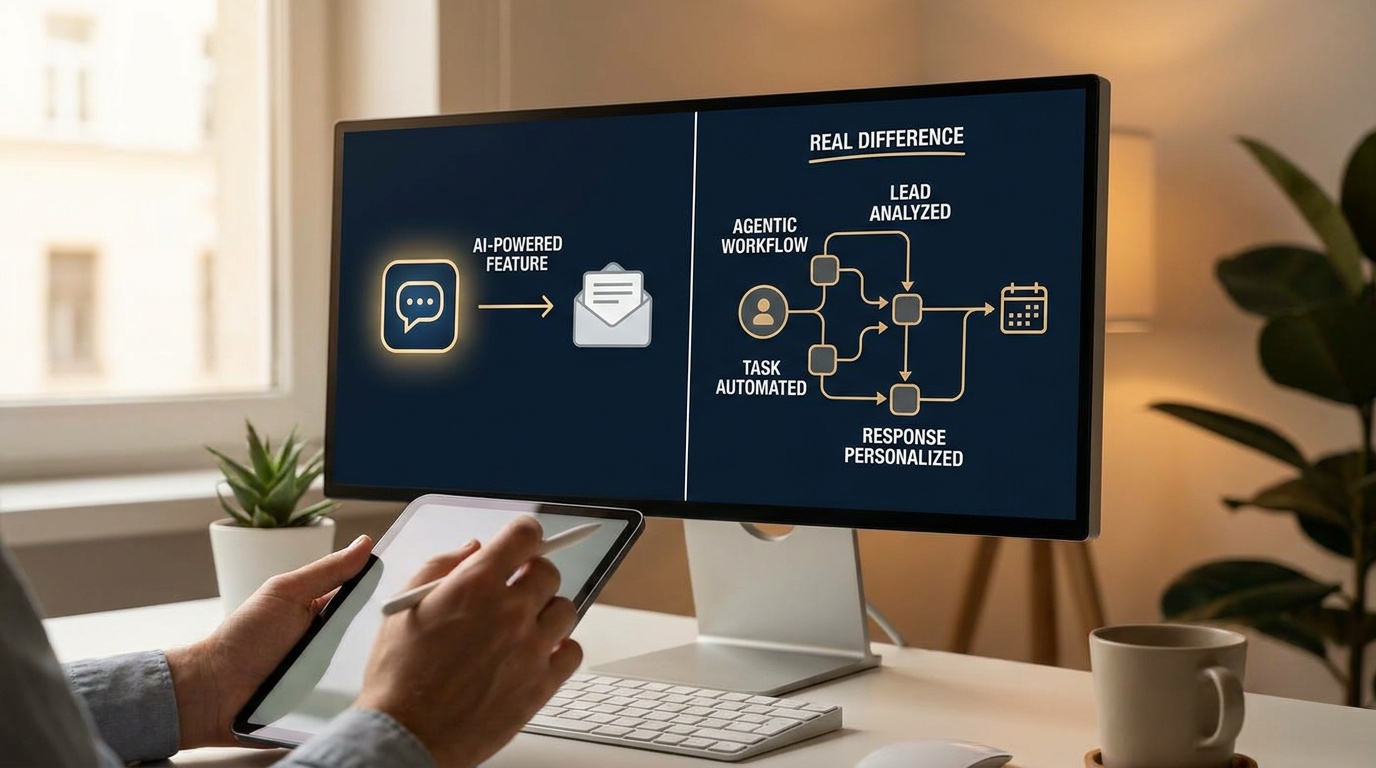
A feature does one thing, at one moment, when you ask it to. It drafts a text. It scores a lead. It answers a question in a chat widget. Useful, but bounded. Someone still has to notice the output and decide what happens next.
A workflow is different. It's a job with a defined start, a set of decision points in the middle, and a specific outcome at the end, and it runs without a human prompting every step along the way. That's the actual definition of agentic: a system that pursues a goal with limited supervision, deciding its next move based on what it observes rather than executing a fixed script. The Congressional Research Service's brief on agentic AI draws this same line, distinguishing systems that act autonomously toward a goal from traditional software that requires a person to direct each individual step.
McKinsey's research on how generative AI is transforming sales and marketing frames this the same way at the operational level: the real gains show up when AI executes a multistep process autonomously, not when it adds a smart label to a single task. That's the distinction worth carrying into every vendor conversation you have this year.
Felix, Fello's AI teammate, is built around this same trigger-to-outcome principle. He doesn't wait to be told what to do next once a lead or a database contact engages. He reasons through what's happening and keeps moving toward a real handoff.
What a Defined Workflow Actually Looks Like: New-Lead Response
Lead response is the easiest place to see this play out, because most teams already know exactly what's broken about the traditional version.
A new lead comes in. It hits the CRM, an alert fires, and then everything depends on a human noticing it, having bandwidth at that exact moment, and remembering to follow up a second and third time if the first attempt doesn't land. When any one of those breaks down, the lead goes cold. Nobody decided to lose it. It just fell through a gap that was never actually closed.
A feature-level tool patches one piece of that gap. It might auto-tag the lead as "hot," or draft a first text for the agent to send. Useful, but the human still owns the next ten decisions.
An agentic workflow owns the whole sequence. It reasons about who the lead is and what they're looking for, reaches out immediately across the channels they'll actually respond to, adjusts its tone and timing based on how they engage, keeps the conversation going instead of stopping after one attempt, and hands the conversation to a person the moment real intent shows up, with full context attached. That's Fello's model in practice: Fello surfaces the opportunity from your database, Felix works it as your AI teammate across calls, texts, and emails, and your team closes it once a real conversation is warm. Felix doesn't stop at qualifying and dropping a name in an inbox. He keeps the conversation moving until there's a meaningful next step or a handoff ready for a human.
That's the shape of a real workflow: trigger, reasoning, action, adaptation, outcome. Compare that to a drip campaign that fires message four regardless of whether the contact opened messages one through three. Same channel, completely different category of software.
The Same Logic Extends Beyond Lead Conversion
Once you can see the trigger-to-outcome pattern in lead response, you start noticing where else it applies, and where it doesn't yet.
Follow-up across your existing database is the most direct extension. The contacts sitting in your CRM who asked a question six months ago, browsed a home value tool, or went quiet after an initial conversation are the same kind of opportunity as a brand-new lead. They need the same reasoning, adjust, and hand-off sequence, not a one-time reactivation blast. Felix works these opportunities the same way he works a brand-new lead: reasoning through the context, reaching out across calls, texts, and emails, adapting based on how the contact responds, and handing off once there's real intent.
Recruiting outreach follows a conceptually similar pattern: a system that tracks signals about agents who might be open to a conversation, reaches out consistently, and routes a warm response to a recruiter. It's the newest application of this logic in real estate operations and, for most teams, the least mature one right now. Worth watching, not yet something to assume every vendor has fully built.
Retention and customer experience work the same way on the other end of the relationship, checking in with past clients, catching signals that someone's ready to transact again, and keeping the conversation warm without waiting for a person to remember to reach out. We go deeper on what a defined customer experience workflow actually requires, including the escalation path back to a human, in our breakdown of the AI customer experience gap in real estate.
The common thread across all of these is that one system can coordinate multiple defined workflows off the same underlying database, instead of stitching together a separate point tool for each job. That's what it looks like when a single AI teammate runs coordinated operations for a larger team instead of fragmented automation bolted on one tool at a time, a pattern we cover in more detail in our look at how mega teams are replacing fragmented automation with agentic operations.
What This Means for Your Team's Production, Not Just Your Tech Stack
None of this matters if it stays theoretical, so bring it back to what you're actually trying to fix.
If leads are going cold between the first attempt and the second, that's not a lead-quality problem. It's a follow-up workflow that's missing a piece. If your database has thousands of contacts nobody's touched in months, that's not a reason to buy more leads. It's an opportunity that a defined workflow is built to work. That's the exact job Felix is built to do: surface the opportunity sitting in your database and work it, across calls, texts, and emails, until there's a real conversation ready for your team to close.
This shift is already underway across the industry, not just a future trend to plan around eventually. A recent survey on brokerage AI adoption found that roughly half of brokerage leaders plan to adopt or expand agentic AI tools rather than treat it as experimental. That means the leaders sorting substance from buzzword right now are the ones who'll have a real answer when their agents ask what's actually changing.
More leads don't fix broken follow-up. A defined workflow that owns the follow-up, whether that's a new inquiry or a contact who's been sitting in your database for a year, is what actually changes how much of your generated opportunity turns into a closed deal.
Three Questions to Ask Before You Call Something Agentic AI
Use these the next time a vendor tells you their product is AI-powered.
1. What workflow does this run, start to finish, without me? If the honest answer is "it flags something and puts it in your inbox," that's a feature, not a workflow. If they can name a specific job with a beginning, decision points, and a defined end, like a cold contact becoming a booked appointment, that's the real thing.
2. What happens after the first attempt doesn't work? A real workflow adapts and tries again through another channel or a different angle. A feature typically stops and waits for a person to notice and restart it.
3. Who does it hand off to, and when? Agentic AI in real estate should end in a warm conversation for a human to take over, not a fully automated close. If a vendor claims their AI closes deals without a defined handoff to a person, that's a red flag worth asking more questions about.
Frequently Asked Questions
Is agentic AI the same thing as a chatbot?
No. A chatbot answers questions in the moment you ask them. Agentic AI reasons through a goal across multiple steps and adapts based on what happens along the way, without needing a person to prompt each move.
Does agentic AI mean my team needs fewer people?
No. Agentic AI is built to handle the volume and consistency of follow-up that no human team can sustain alone, especially across a full database. It's meant to free your agents and ISAs to spend their time on the conversations that need human judgment, like negotiating and closing, not to replace them. That's the design behind Felix, Fello's AI teammate: he handles the reasoning and repetitive follow-up so your team's time goes toward the conversations that actually close.
How is this different from the automation my CRM already has?
Most CRM automation runs on fixed rules: a set number of emails on a set schedule, regardless of what the contact does. Agentic AI adjusts its next move based on real behavior, like whether someone opened a message, engaged with content, or went quiet, and it coordinates that reasoning across channels instead of running each one separately.
Is recruiting really an agentic AI workflow yet?
Conceptually, yes, the same trigger-reasoning-action pattern applies. In practice, it's newer and less mature across the industry than lead response and follow-up. Treat vendor claims here with a bit more scrutiny and ask for specifics.
What's the biggest mistake teams make when evaluating "AI-powered" tools?
Judging the tool by its feature list instead of asking what job it owns end to end. A long list of AI-labeled capabilities can still leave every actual decision and handoff sitting on a person's plate.
Buying Tip
Before your next vendor call, write down the question this article gave you: "What workflow does this run, start to finish, without me?" Ask it plainly. If they can walk you through a specific job with a clear trigger, real decision points, and a defined outcome, you're looking at something real. If they pivot back to a feature list, you have your answer.
The Bottom Line
"AI-powered" was never a meaningful claim. It's a label, and labels don't tell you what software actually does for your team's production. Agentic AI is a specific, testable category: a system that owns a defined workflow from trigger to outcome, reasoning and adapting along the way, and handing off to a person when a real conversation is ready.
Lead response is the clearest place to see it, and the same logic extends to follow-up, recruiting, retention, and customer experience as the pattern matures across the industry. Fello finds the opportunity in your database, Felix works it as your AI teammate until there's a meaningful next step, and your team closes it. If you want to see what that actually looks like running in practice rather than described in a pitch deck, that's the conversation worth having next.